



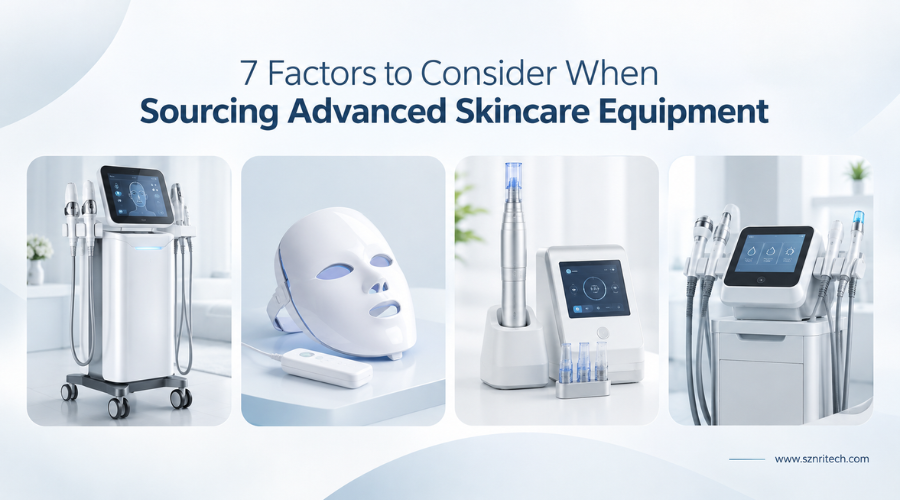
• Certifications distinguish real medical-grade products from fakes.
• Machine durability depends on the quality of its components.
• Minimum order quantities and customization vary widely among factories.
• Warranty terms can often provide more information than the spec sheet.
• Testing the samples first avoids costly errors when ordering in bulk.
When you're purchasing advanced skincare parts, you are not purchasing retail skincare items. One weak machine can hurt a client. If the documentation lacks one, a shipment can be stuck in customs for several weeks. Here, there is less room for error, and the checklist must conform to that.
Here are 7 factors that really count when assessing an advanced skincare equipment supplier, and they extend beyond certifications to the warranty's expiration.
Avoid any supplier that cannot provide good documentation. Check for CE marking in accordance with EU MDR 2017/745, FDA clearance for availability in the USA, and ISO 13485 for medical device quality management. These aren't optional extras. They are the baseline of a manufacturer vs. an assembler putting a brand name on a generic product. Always check all certificate numbers with the certificate issuer. Do not believe a logo that is placed on a brochure. If a supplier avoids sharing verification details, they are communicating something, even if they don't say it.
Read the specs carefully and don't pay too much attention to the headline features. Ask about the brand of laser diode, RF generator, or ultrasound transducer inside the machine. Cheaply made components perform less reliably and are harder to replace because the original manufacturer will no longer respond to your emails.
The rated lifespan is also a factor. The rated life of diode laser bars is typically 20 – 50 million shots. RF handpieces should also include a cycle rating, typically 50,000 to 100,000, indicating when they start to lose quality performance. Request this information in writing, rather than verbally promising it during a sales call.
Verify the sample is identical, regardless of component brands or energy-level ranges. Use it in your clinic for at least two weeks before placing a bulk order.
A real manufacturer designs circuits, designs software, and incorporates handpieces in-house. An assembler purchases generic parts and assembles a shell around them. Inquire about the number of engineers in the factory and about the number of patents. If you're not sure of the answer here, it's strongly indicative that little engineering was done behind the scenes. This pertains to your future, not just to the order you're doing. In-house R&D translates to software updates, custom features, and quicker, easier fixes if something goes wrong. Assemblers can't modify what they didn't design. If something breaks outside of the warranty, you are often left with a problem to fix.
Fixed ordering quantities change frequently, depending on the machine's customization. Sometimes, stock models are shipped in quantities of 1 to 5 pieces per trial order. Changes to custom branding or housing typically cause MOQ to rise from 20-50 depending on the amount of money that goes into the change. The curve is similar for pricing. Mid-range users can get HIFU or RF, for example, for $2,000 to $8,000 per piece with low volume, but go down 10 to 20 percent each time the fifth of six sales are made. Break down each quote into its individual elements, rather than a single total. So the divide in that reflects where the money is going.
The main machine normally comes with a 12-month warranty. If it's any shorter, it's a warning sign to ask about separately. Make sure to see what is covered because it is impossible to have a warranty if a clinic uses the items in its regular way.
Nothing really comes close to the images and literature of a factory that can convey that. Ask to see a live video visit or have an independent check for large quantity orders. One small price for an order of tens of thousands of dollars is $300-800 for firms such as SGS or Bureau Veritas to come in and audit. An audit will involve searching for a clearly marked QC area close to final pack. Inquire about the number of units that are tested for aging before they are sold and how long they are held for aging. Some good manufacturing companies run the machines for 24-72 hours before packing and loading them onto trucks, without allowing anything to break, before they reach a customer.
A machine can accomplish nothing without a man to run it. Check if the supplier offers training, video instructions, or remote assistance for troubleshooting. Some factories offer live operator training via video call or in person, which can make all the difference for clinics new to the technology. Of course, response time plays a role here. A supplier who will respond within 24 hours of problems happening is far better than a cheaper one who will stay quiet and say nothing after the deal. Consult with current customers on this in particular, not on the supplier's claims.
Consider more than the first year. Once the warranty expires, ask how quickly they can replace handpieces, cartridges, or consumables. Some factories keep stock on hand for immediate shipping. Others make parts to order, where it's possible to wait six weeks, thus ending a treatment room's booking schedule. Check the prices of regular replacement items in advance. If handpieces or cartridges cost more than competitors, a low-sticker-price machine can become very costly very quickly. Request parts quote when you make your initial quotation request.
Perform a test run for two weeks or more as per the actual treatment application. Review consistency in repeatability, cooling performance, and whether display or safety features operate exactly per the spec sheet.
Take at least three quotes before ordering in bulk quantities. While unit prices are important, also consider landed cost, which can vary based on freight, duties, and documentation costs. What looks cheap with weak or uncertain support or unclear certification strikes worse in the event of issues. Request references from the supplier that are in a comparable market. A confident supplier can readily give their name without hesitation. Call 2 or 3 references and ask about delivery accuracy, batch-to-batch consistency, and dispute resolution. Simple as this, it will tell you more than any spec sheet.
Each order should include a Certificate of Analysis, test report, user manual, CE/FDA documentation copies, and an exact duplicate packing list with the invoice. One of the most common issues that delays advanced skin care products at customs is missing documentation. Request packaging photos before the factory ships the package. Check to see that the labeling, counts, and box condition are the same as ordered. This takes only 10 minutes and can catch errors before they become a problem once the container is on the ship.
If buyers stick to the brochures, they may miss out on higher-end skin care equipment. It's not about a slick sales presentation; it's about certification, part quality, and genuine research and development capability. Test a sample, audit the factory for large orders, and ask tough questions about support and spares before buying in. Those foundations will secure your investment for times to come after the first delivery.
What is the name of a bulk supplier of advanced clinical skin care devices?
Licensed manufacturers are usually ISO 13485 and CE certified, and they will order 5 – 20 units and above.
What is the wholesale price of advanced skincare equipment?
The normal wholesale price for a unit is $2,000 to $8,000 per unit, based on technology type and quantity to order.
Who is a custom advanced skincare equipment supplier with branding options?
OEM manufacturers provide custom housing, logos, and interface language options, and their MOQ can be as low as 20-50 units.
Who offers bulk advanced skincare equipment with customization at discounted rates?
Many suppliers offer 10-15% discounts on custom bulk orders of over 50 units.
What is the average time to get custom equipment?
Custom orders will typically take 4-8 weeks after the sample is approved, and it varies with component sourcing & quantity.
Highlights • Certificati
READ FULLHighlights • Fla
READ FULLBeauty clinics nowadays require numerous instruments to make their customer satisfied. One mach
READ FULL

Have a question or need a quote? Fill out this form and our team will get back to you quickly!
