



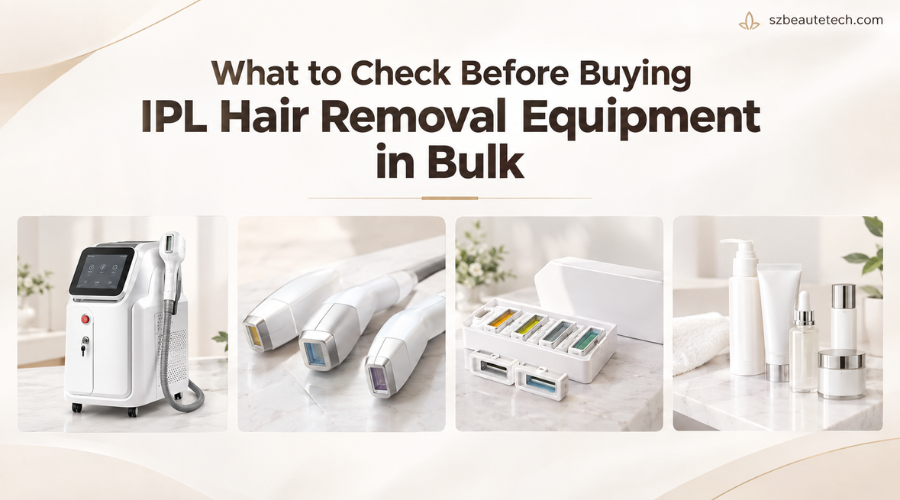
• Flash count and energy output determine real long-term value.
• Wavelength Range: which zone of skin tones can be treated safely.
• Marketing claims are not as significant as certifications.
• The warranty specifications may provide more information than the spec sheet.
• Most problems can be detected by sample testing before ordering in bulk.
Buying a single IPL device for a single clinic differs from buying it in bulk. A wrong decision can be multiplied. One weak handpiece becomes twenty. An entire cargo shipment could be held up at customs if one certificate is missing. So the consequences are greater, and the checklist is longer as well. This article walks you through the key factors that affect safety, resale value, and repeat orders.
A single unit mistake costs one refund. One wrong order results in a whole lot of unsold goods in the warehouse. That is the hard truth. If you're considering ordering a large quantity before you've seen proof, proceed with caution and don't take any spec claims as true. Ask for test reports, not adjectives. Consistency is the second risk faced by buyers. All ten units in the same batch should be identical. Sometimes factories will ship flash- or energy-different units, or sell a factory for different numbers of flashes or different energy output under the same model. Ask for batch testing information rather than overall product line information.
Flash count is how many times a lamp can be used before it stops working. Entry-level IPL flash lamps emit 100,000-300,000 flashes. Professional-grade units often reach 500,000 to 1,000,000. Don't buy before calculating. The clinic delivers 20 treatments a day and 10 flashes per treatment, which equals 200 flashes daily. If this is the situation, the 300,000-flash lamp would last approximately 4 years. The 100,000-flash lamps have a shorter lifetime than one year. As you would for a flash power boost, don't take a maximum quantity for granted; request actual flash time.
IPL devices emit a wide spectrum of light energy typically ranging from 400nm to 1200nm. Wider ranges are used to cover more skin colors but can make it more difficult to ensure proper filtering, raising the risk of burns. Check for adjustable cutoff filters, usually at 530nm, 590nm and 640nm so that operators can select the correct wavelength depending on the client's skin type. Darker skin types will require longer wavelengths to prevent over-absorption by melanin. Machines that do not have a 640nm+ filter option are not safe for Fitzpatrick type IV through VI skin. If your buyers are diverse, this filter range is not an option. Verify it before placing an order!
Look for a CE mark under EU MDR, FDA clearance for the US market, and IEC 60601- 1 for electrical safety. Verify certificate numbers with the certificate issuer. If a factory does not share documents, it is a red flag you need to consider.
Energy output is given in joules per square centimeter, typically 1-50J/cm² from IPL devices that can be adjusted. The maximum output is adjustable for any level of hair density; dark hair can be adjusted to a higher maximum output, but it may burn if operators are not trained correctly. Describe the device's safety features, including (but not limited to) skin contact sensors to prevent firing without skin contact.
Spot size can affect treatment speed. Common sizes range from 10x10mm in small sizes up to 16x50mm in large-area handpieces (backs and legs). Larger spot sizes will illuminate a larger surface per flash, but will require more energy to remain effective. Size the spot in proportion to the actual treated areas your buyers will use the most.
Cooling is important as well as the output of light. If cooling is weak, the client is uncomfortable and slow treatment rates are possible. A popular range for these units is between 5°C and 10°C, and contact cooling is now standard on professional units. Ask if the cooling is continuous or alternating on/off, as this can increase the chances of burning during longer sessions. When handpiece quality starts to suffer, users often overlook its user-centric design. Look at cable flexibility and connector type. Even with a lot of usage each day, cables break where they connect. For commercial-grade equipment, 50,000 cycles of continuous clinic use is reasonable to consider.
Generally, minimum order quantities for IPL hair removal equipment bulk begin at 10-20 units. For new buyers testing the relationship, there are factories that provide a lower trial MOQ of 3-5 units. You may see price reductions of 10-15% at 50+ and larger discounts at 100+ units. There is some variation in price according to the tier. The basic bulk IPL systems typically cost $400 to $900 per unit. Professional models start at $1,200 and can reach $3,000. Multihandpiece systems with high output can cost over $4,000. If the price is below these ranges, that generally indicates a lower-quality lamp, light housing, or lack of safety features.
Get a sample in the first place and test for at least 2 weeks. Make sure that energy is consistent during various flashes, cooling is maintained upon repeated use, and that display and safety sensors perform as advertised.
A factory audit is more than just a photo visit. Request to view the assembly line, incoming component check area, and final test station. A factory that validates all products before shipment should have logs or a QC cell visible near the packing area. One that cannot demonstrate where testing occurs at all.
Third-party inspection services such as SGS or Bureau Veritas typically charge between $300 and $700 per inspection. Small compared to a large purchase in the hundreds of thousands of dollars. Always use one before an order of 50 units or more, even with a factory you have done business with before.
Warranty length is a good suggestion of manufacturer self-confidence. Be sure to check 12-24 month warranties on the main unit, and shorter ones, typically 6 months, on the lamps, or other consumable units. Specify what will invalidate the warranty. Some factories exclude damage from normal clinical use, which is no benefit to having a clinic. Availability of spare parts is as important as the warranty period. Find out the delivery time for replacement handpieces and lamps, and whether the factory stocks or builds the pieces to order. Waiting for weeks for a replacement lamp can stop a clinic's booking schedule for weeks.
Each shipment must contain a Certificate of Analysis, User Manual, Copies of the CE/FDA documentation, and a packing list identical to the invoice. One of the most frequent Customs delays in bulk IPL shipments is missing paperwork. Request pictures of the packaging that come before the shipment leaves the factory. Re-test that "label, boxes, counts" match. This step is easy to complete and can capture a surprisingly high volume of errors prior to your port problem.
Buying IPL equipment in bulk means paying attention to details others might overlook. Having a glossy brochure isn't a bad idea, but flash counts, wavelength range, and real certifications are more significant. Taste a sample and visit the factory if the order is large; also, read the warranty terms carefully. That base provides you with protection for your margin and your buyers.
FAQS
Who is a bulk supplier of IPL hair removal equipment for clinics?
Some beauty equipment manufacturers are licensed for bulk sales, and often have tiered prices beginning at 10 and 20 units or more.
What is the wholesale value of the IPL hair removal equipment?
The price of wholesale offerings usually falls between $400 for a basic unit and $4,000 for the professional system.
Who is a custom supplier of IPL hair removal equipment with branding options?
OEM manufacturers do provide custom logos and housing colors, as well as software interfaces, typically with a minimum order quantity of 20 to 50 units.
Who offers bulk IPL hair removal equipment with customization at discounted rates?
Many suppliers offer discounts in custom bulk purchases of 10% to 15% when they place orders over 50.
What is the time for the bulk production and shipping of IPL equipment?
Standard models are typically delivered in 2-3 weeks. Custom orders typically take four to six weeks before shipment.
Highlights • Certificati
READ FULLHighlights • Fla
READ FULLBeauty clinics nowadays require numerous instruments to make their customer satisfied. One mach
READ FULL

Have a question or need a quote? Fill out this form and our team will get back to you quickly!
